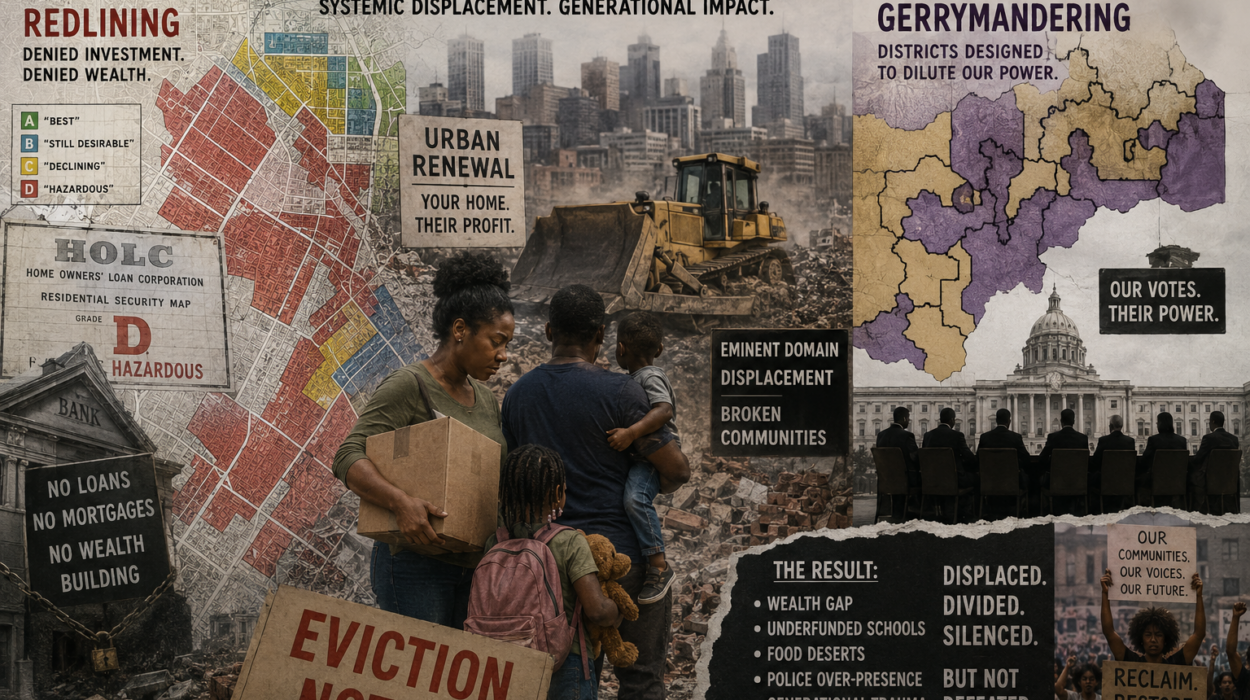
By any measure, the story of Black America is a story of resilience. Communities have been built, rebuilt, and rebuilt again despite obstacles that often appeared insurmountable. Yet there is another story, less discussed but equally important—a story not of what Black Americans created, but of what was systematically taken away. It is a story of roads, maps, zoning laws, and government decisions.
It is the story of displacement.
For generations, Americans have been taught that highways symbolize progress, urban renewal represents improvement, and development signals opportunity. But for many Black communities, these projects often delivered a different reality. Behind the language of modernization lay policies and decisions that uprooted families, destroyed businesses, erased wealth, and fractured neighborhoods that had taken decades to build.
The Federal-Aid Highway Act of 1956 launched one of the largest infrastructure projects in American history. The Interstate Highway System connected cities, expanded commerce, and transformed transportation. Yet the benefits were not shared equally.
Across the nation, highway planners frequently routed roads through Black neighborhoods rather than wealthier white communities. Officials often justified these choices by describing the targeted areas as “blighted” or economically depressed. What they rarely acknowledged was that many of these neighborhoods had been intentionally deprived of investment through redlining and discriminatory housing policies. In effect, government-created conditions became the justification for government-sponsored destruction.
The results were devastating.
In New Orleans, the construction of the I-10 Claiborne Expressway cut through the heart of a thriving Black community. Hundreds of homes were lost. Concrete pillars replaced Majestic oak trees that once lined Claiborne Avenue. A vibrant cultural center that helped define Black life in the city disappeared beneath the highway.
In Syracuse, New York, the I-81 viaduct bulldozed the historic 15th Ward, a flourishing Black neighborhood. The highway became a physical and economic barrier that divided communities for generations.
In Houston, Interstate 45 cut through Independence Heights—the first incorporated Black city in Texas—and portions of the historic Fifth Ward. Families lost homes, businesses vanished, and opportunities for passing wealth from one generation to the next were severely diminished.
Perhaps nowhere is this pattern more clearly visible than in Portland, Oregon’s Albina District.
For much of the twentieth century, Black Portlanders were effectively restricted to Albina through discriminatory housing practices. In 1919, the Portland Realty Board adopted policies that discouraged property sales to African Americans in many parts of the city. Redlining further reinforced segregation, limiting where Black families could buy homes and build businesses.
Then came a series of disruptions.
The Veterans Memorial Coliseum project displaced hundreds of residents. The construction of Interstate 5 split the neighborhood in two. Later, the expansion of Emanuel Hospital cleared more than 200 properties. Residents were promised replacement housing that never materialized. Vacant lots remained where homes and businesses once stood.
By the 1990s and early 2000s, a new force emerged: gentrification.
As property values rose, many longtime Black residents found themselves priced out of the very neighborhoods they had sustained through decades of neglect. Between 1990 and 2010, Portland’s historically Black Albina area lost more than 11,000 African American residents.
The community had survived segregation, only to face displacement through redevelopment.
The consequences of these actions extend far beyond bricks and mortar.
When a neighborhood is dismantled, social networks disappear. Churches lose congregants. Small businesses lose customers. Families lose connections to neighbors who provided childcare, mentorship, and emotional support.
Community leaders often describe displacement as a form of grief. It is the loss of familiar streets, trusted faces, and shared history. It is the disappearance of a place that helped define who people are.
The health consequences have been equally severe.
In many cities, highways and industrial facilities were concentrated near Black neighborhoods. Residents were exposed to higher levels of pollution, increasing rates of asthma, respiratory illness, and other health conditions.
In Houston, communities such as Kashmere Gardens have long faced environmental hazards associated with nearby industrial activity. Similar patterns appear across the country, where minority neighborhoods have disproportionately borne the burden of environmental risks.
These outcomes were not accidental. They emerged from policy decisions that consistently placed certain communities in harm’s way while protecting others.
The question, then, is not simply what happened. The question is who had the power to decide.
That question remains relevant today.
Across America, governments are now confronting the legacy of infrastructure projects that divided neighborhoods. Efforts are underway to remove aging highways, reconnect communities, and address historical harms.
In Syracuse, state officials have proposed replacing the I-81 viaduct with a community street grid designed to reunite neighborhoods and improve quality of life.
Supporters see an opportunity for healing. Critics worry that revitalization may trigger another wave of displacement through rising property values and redevelopment pressures.
Portland faces similar debates. Community advocates have demanded that transportation projects include meaningful commitments to repair past harms and prevent future displacement. Many residents argue that true restoration requires more than construction—it requires local control, protections for affordable housing, and genuine community participation.
At its core, this conversation is about democracy.
Voting matters. Representation matters. But communities also measure democracy by whether they have a meaningful voice in decisions that affect their homes, schools, businesses, and futures.
The history of Black America contains countless examples of communities being acted upon rather than consulted. Highways were built. Neighborhoods were cleared. Boundaries were redrawn. Decisions were made.
Often, the people most affected had little say in the outcome.
Today, as cities pursue redevelopment and infrastructure improvements, the lessons of the past remain clear. Progress cannot be measured solely by miles of roadway or dollars invested. It must also be measured by whether communities are strengthened rather than displaced.
The enduring question is the same one that has echoed through generations of Black American history:
Sources:
Urban Renewal History and the I-5 Rose Quarter Improvement Project
The New York highway that racism built: ‘It does nothing but pollute’
The Highway That Sparked the Demise of an Iconic Black Street in New Orleans
Displacement in North and Northeast Portland
BLACK AMERICA HAS SEEN THIS BEFORE — NOW THE WORLD IS SEEING IT IN VENEZUELA
Freeways force out residents in communities of color — again